Introduction
The problem of ‘values’ pursued in classical sociology has always stressed the connections between ‘values’ in the sense of belief ystems, and actual ways of life of the believers. Ways of life affect beliefs (and can contradict them) in a number of ways, as well as the converse. What follows is a very condensed (and inevitably rather dogmatic) exploration of these points.
Social pressures towards moral relativism
To summarise a great deal of work very quickly, the ‘founding fathers’ of Sociology identified a number of aspects of ‘industrial society’ (or capitalism’, or what is now fashionably called ‘modernity’) which threatened the value-base of earlier forms of social life. They include:
1. A well-developed
social
differentiation
(or division of labour) in work and in social life
-- e.g.
the appearance of experts, specialist and
professionals
2. The generation of substantial social inequalities of wealth, income and power, and the possible fracturing of societies into conflicting groups
3. Increasing social
contacts between
different societies and ways of life
(recently on a global
scale)
4. The dominance of economic, political and administrative regulation (‘system’ requirements) over the social and personal lives of citizens (‘lifeworld’)
Postmodernism
‘Postmodernism’ refers
to a
recent
Parisian social poetics (Baudrillard (1983) and Lyotard
(1986) are the
classic choice as spokespersons) which predicts an
extreme and
unfortunate
(and rather selective) combination of these trends. An
explosion of
cultural
difference, driven increasingly by the mass media
destroys the old
bases
of community and community values (and also makes
redundant the old
social
sciences). Lacking any sort of restraint in community
life, culture is
left free to develop its own momentum, to endlessly
develop and stock a
‘cultural supermarket’ of values and beliefs (in this
case)
--
those seeking guidance can access equally easily
information about Feng
Shui, Buddhism, Californian mysticism, the Toronto
Blessing, the Dead
Sea
Scrolls, Cornish satanism, or hypnotism, and will
probably pursue these
paths sequentially.
For Baudrillard, an
initial
cultural
explosion will lead to an implosion, the celebration of
difference will
turn to a deep indifference, at least as far as ‘the
masses’ are
concerned
(for professorial poets there was the attractive
prospect of cultural
experimentation
without guilt). A cynical refusal to communicate would
characterise the
imploded society, leaving professional
communicators --
priests
and teachers as well as advertising men and spin
doctors --
babbling
competitively into a black hole. For Lyotard, there was
at last a
suspicion
that the cultural differences he had initially hailed as
liberating
were
dangerously consonant with the modern global cultural
industry and its
requirements for endlessly restless consumers with short
attention-spans.
He holds out only a weak hope that some kind of
avant-garde cultural
elite
will pursue the ‘good’ sides of relativism (seeking the
sublime).
Critical Theory
This tradition is
rooted in
the classical
work of Weber and Marx and offers a stern germanic
counter to the
stylistic
fireworks of postmodernism. Instead of an unlikely moral
relativism,
the
work predicts a kind of secularisation. The analysis
starts with the
growth
of a particular type of ‘purposive rationality’ in
modern societies,
one
which stresses the effective calculation of means and
ends instead of
the
considered application and development of ‘values’ (some
vision of the
‘good life’). This sort of hard-nosed rationality
is rooted in
the
economic system, and it spreads also into the classic
bureaucracies of
modernity -- the Civil Service. System
growth takes on a
life
of its own, unconstrained by any values other than the
effective
pursuit
of measurable goals (often things like growth for its
own sake). As
system
dominates lifeworld, a public sphere for the debate and
discussion of
values
diminishes -- political debates focus
exclusively on the
efficient
running of the economy, or on the best means to achieve
cuts in public
expenditure Other types of rationality (or Reason),
based on the
pursuit
of the ‘good life’ for human beings (such as a fair and
just society,
one
which minimises exploitation and so on) do not entirely
disappear, but
they are pushed back further and further into a purely
‘private’ or
personal
realm as system requirements dominate more and more of
public or
community
life. This privatisation of values can lead to a
dangerous
outcome
-- a deep irrationality, with values informed by
emotional
commitments
strengthened by occasional mass outbursts of emotional
solidarity. This
kind of outburst and its exploitation was a major factor
in the success
of fascism, where public policy was pursued to provide
emotional
gratification,
and where mass myths developed at the heart of politics
(such as the
Nazi
celebration of the mysteries of ‘blood, race and soil’
as the basis for
German nationhood). The aggressive side of these
emotional commitments
became rapidly apparent to outsiders, of course.
Critical theory thus aimed to preserve Reason against both the slow colonisation of systems thinking and the deep irrationality of mass affect. In its most recent form, this appears as Habermas’s (1987) counterfactual assertion’ of the potential of unrestrained speech, devoted to the pursuit of the better argument, and always able to raise doubts about the validity claimed by the statements of others. Habermas (1976) contrasts this kind of ‘ideal speech act’ with the ‘distorted’ or ‘strategic’ communication so commonly found in public life, which represents specific interests as universal ones, and often allows no challenge to its validity claims.
Case-studies 1: Mourning Diana
What best
characterises the
public
reaction to the death of the Princess of Wales? For some
commentators,
the extraordinary scenes signified a new spirituality,
with a
delightfully
playful (postmodernist?) combination of Christian ritual
and Elton
John.
(This seems to be part of an interesting argument
developed by Dr G
Davie
at a presentation at Exeter University, 4th December
1997, for example)
Strange combinations occurred of British national ritual
and most
un-British
public applause during and after the ceremony itself.
For others, a new
sense of community emerged as everyone joined together
in mourning,
forgetting
their differences – even Diana was ‘one of us’.
Specialist commentators
on cultural politics, like the eternally optimistic
Martin Jacques
(1997)
, combined both themes, seeing the mourning public on
the march as a
New
Social Movement based on feminine virtues like
compassion and the open
recognition of emotion, and a generational rejection of
royal tradition
and elitism. Moral relativism, and the heartlessness of
Thatcherism
were
both decisively rejected in what Jacques referred to
(with a playful
intertextual
reference back to the 1960s) as the ‘floral revolution’.
Things, he
assured
us, would never be the same.
For other commentators, however, darker notes were detected, best of all, perhaps in Christy (1997). The role of the media were noted in amplifying and shaping the public’s grief. Some psychological commentaries detected guilt and aggression in the public mood, as demands were made, of Royals and ordinary mortals, for ‘proper signs of respect’. It was necessary to cry, for example, or to observe a respectful silence in the neighbourhood during the funeral. The suspicion grew in some quarters that this was one of those dubious public spectacles after all, where unfocussed emotions were released as a kind of irrational substitute for public debate.
Spokespersons hastened
to
add their
spins – -- Tony Blair extended his role as a politician
of the heart,
claims
were made for young princes as successors to the Diana
heritage. After
all the mediated mourning, at least commercial life
seemed to continue,
unreformed, just as before with a massive exercise
to market
souvenirs.
‘Values’ were expressed in a characteristic manner
-- in
private,
en masse (the two are complementary), as a temporary
holiday from ‘real
life’, and, eventually as a form of consumption.
Case Studies 2: British Higher Education
One of the main reasons for turning to specific cases is to show the complexity of actual social life (a theme at the heart of proper sociology, but sadly lacking in either Parisian poetics or critical theory on the grand scale). Nothing could be more contradictory than higher education systems in terms of their values. It is common to think of education as offering a set of values, ones sometimes defined in terms close to those of critical theory, especially Habermas’s ideal speech act, perhaps (the perfect university seminar?) -- yet the practices of educational institutions often contradict these values. Higher education often relativises as well, for example, as young people encounter members of other societies or other subcultures with quite different but seemingly equally adequate ways of life. In close proximity, it becomes impossible to rank order such differences. The very academic subjects studied can encourage a questioning of values which once were held without question, of course, as students learn to philosophise or theorise. In the (urban, cosmopolitan) academy above all, young people can best experience that relentless drive of modernity poetically described by Benjamin (see Clifford 1988) -- propelled into an unknown (social) future, facing backwards, aware of past identities yet unable to conceive of a future based upon them.
Parisian
postmodernists are
not the
first academic specialists to have been led to
relativism by following
theory to its logical (but perhaps not sensible)
conclusions, or to
have
found in the position of the university professor the
perfect example
of
leisured dilletantism and a sophisticated ennui.
The impact of
these
trends and practices on more ordinary people is rarely
discussed or
analysed,
however, in favour of little more than a hope that,
eventually, some
resolution
will occur.
Notions of the ‘good
life’
haunt
the loftier debates about the role of the academy. Our
own institution
apparently has a ‘vision statement’ which mentions that
ancient goal of
a ‘concern for truth’. Yet increasingly, actual
institutions are
colonised
and dominated by calculative rationality -- the
requirements of
rational
budgeting and marketing, the mechanisms for targetting
and recruitment,
the advocacy of ‘closer links’ with the economy. These
links can be
found
explicitly in vocational curricula, where the pursuit of
the better
argument
has to be limited by the ‘needs’ of the job market. Less
explicit, but
as powerful, is the penetration of rational technique in
modes of
teaching
and learning -- the specification of
objectives, the
calculation
of the most effective means to achieve them, the
apparatus of ‘study
skills’,
the paraphernalia of measurable ‘outcomes’. Finally, the
systemic needs
of effective grading and classification can produce a
deep
instrumentalism,
and the triumph of strategic or distorted communication
among students
and staff. None of these techniques are interested in
‘truth’ of
course:
it is not a concept in calculative-rational discourse.
Concluding Thoughts
The relativism
celebrated
by postmodernism
is better thought of as a special professorial and
poetic case of
the privatisation of values described in critical
theory. In that
context,
the apparent re-emergence of emotional commitments and
visions of
community
in events like the mourning of Diana is a worrying
trend, not one to be
celebrated.
Postscript
Looking back now, in January 2000, the impact of the cult of Diana seems all but diminished. There is to be some sort of permanent Diana memorial, it seems, but there has been no floral revolution, no feminisation of British society, and, in a retrospective millenial edition, two Observer journalists re-published accounts that were openly and courageously critical of the event:
Ferguson (1999) mentioned a 'public enforced outpouring [of feeling]...[with]...attendant censorship of any views not deemed to be sufficicently black-bordered...lunatic aspects [of crowd behaviour], the visions and the portents...and [a] more subtle worry...the number of sane, intelligent,compassionate people...who are obviously moved absolutely beyond words...I honestly hadn't understood how many people truly treated Diana as an icon. And I don't know how healthy it is for so many to have adored someone they had never met,and, it appears, lived their lives vicariously through her'
The Observer also reprinted Pearson's (1999) account of the famous Diana broadcast on public TV (on Panorama, a prestigious BBC current affairs programme, 20th November 1995): 'Most were transfixed by adoration...[but Pearson saw a]...queasy blend of therapeutic self-evacuation and prefab epigrams masquerading as current affairs...Nothing was left to chance.Candour was never more candid...The programme was ...spliced together from different sessions, almost from different takes, you might think...The interview was instantly hailed as a blow against the Establishment. Maybe so; but it was also a cheapening of public discourse that...will hurt everyone in the end. TV like this makes bulimics of us all: we gorge on it, throw it up and end up wanting more'
Postscript 2
In April 2004 I found a piece by W Merrin on the
media-event of the
death of Diana, and I have made some notes on it -- click here
Returning to higher education, attempts to turn to ‘values’ by organisations already dominated by purposive rationality seem doomed, whether they be companies trying to bolt on some culture or educational institutions trying to put values back on the curriculum (in a nicely modular timetabled slot, of course). At its most pessimistic, critical theory sees a source of resistance to the colonisation of the lifeworld only in the fading memories of those who lived it before the latest incursions. The notion of the university as a place trying to preserve or create the basis for the ‘good life’ could end in irrelevance and nostalgia, or, worse, as a kind of façade, clothing a thoroughgoing educational culture industry: nothing as dramatic as a collapse, more a hollowing out and numbness, perhaps: less abeunt studia in mores than stat magni nominis umbra*.
* apologies for any obscurity -- less study reveals itself in a way of life than only the shadow of a great name remains
References
Baudrillard, J
(1983) Simulations,
New York: Semiotext(e)
Christy, D (1997)
‘Mourning
has
Broken’, the Guardian, September 12th 1997
Clifford, J (1988) The
Predicament
of
Culture: Twentieth Century Culture, Literature and
Art, London:
Harvard Press.
Ferguson E (1999) 'A
tragedy,yes,but
don't tell me I must cry', the Observer, December
19th
1999
Habermas J (1987) The
Theory
of
Communicative Action vol 2 Cambridge: Polity
Press.
Habermas, J (1976) Legitimation
Crisis, London: Heinemann Press.
Jacques, M (1997) ‘The
Floral
Revolution’, the
Observer, September 7th 1997
Lyotard, J-F
(1986) The
Post-Modern Condition: a report on knowledge,
Manchester:
Manchester
University Press.
Pearson A (1999) 'The
Princess
on Panorama: TV to make bulimics of us all', the
Observer,
December 19th 1999
.
go to samples
-
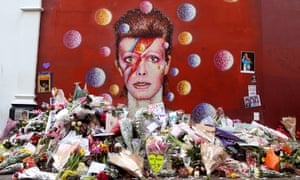
Guess what? Similar moral panic and applied luvviedom
after the death of D Bowie, even linking it all to the
Diana syndrome. This is the second piece by S Moore on
Bowie -- yesterday, she assured us he was not really dead
- -like Christ then?Sentimental shit is good and human
etc,and nothing at all to do with the commercial music
business:
Contact author
Time takes a cigarette and puts it in your mouth. Did that happen? I think it happened, as I reacquaint myself with the nausea of the first fag in a while. Grief is so physical, isn’t it? The discombobulation, that slightly floaty feeling in your legs, a gutful of dread. I know what grief feels like, thanks very much. And I grieve for David Bowie. It’s not a competition. It’s not just about “music”. Or my lost youth. My youth went the day I gave birth at 26 and I understood that everything was about the next generation. And Bowie was always about what could be. A rift has opened between those who know and those who don’t.
I consider myself lucky to have so many compadres of all ages who do know. We are a little afraid of that knowledge these days. We are vaguely aware that we won’t live for ever, but somehow we thought he might. In some new incarnation. We are in denial, maybe.
But it’s not the denial of the naysayers, who function in a most peculiar way. There is a constant refrain of discomfort about public mourning from the zombified bourgeoisie who are fearful of crowds. Fearful of feelings. The joyous celebrations in Brixton were spontaneous. Still the bitter mumblings about the “Dianafication” of England. I wonder if some of these people take Ubers to random funerals and then correct the mourners on the permissible level of emotion. I guess they learn this stuff in public school, where they are taught to confuse empathy with incontinence.
Certainly I got ticked off by several such types when Diana did die and I went to her funeral. I adored her – not because I thought she was Gloria Steinem or a closet republican because she wanted her son to be king instead of Charles – but because she was so brilliantly disruptive. She simply would not accept the royal script: that Charles would keep a mistress and barely see his children. She made her distress clear. She did not want to breed in captivity.
So in 1997, when she died, I had to tell the editor of the paper I worked for at the time that people were genuinely upset. Because they were. Not in a stupid way. Many I spoke to were crying for her, her sons, and for their own losses. They articulated that clearly. This was signalling a cultural shift. Candles and flowers. A Protestant country looked like a Catholic one. Or, sometimes, it was like being in India. For one week, more anti-monarchy feeling gathered than had ever been present in all the hours I spent sitting in meetings about the need for a new constitution.
At the service in Westminster Abbey, when Earl Spencer made his dissident speech to the royals, we thought we could hear rain. It was the gathering applause outside. Nonetheless, people like me were “hysterics”. Saint Christopher Hitchens claimed this mass grief was compulsory (it wasn’t) and called it “a one-party state”. The so-called left is fairly disgusted by the feelings of ordinary folk. Just like the right. This is passed off as a kind of iconoclasm. How very radical not to care about the death of a young mother in a car crash.
So I feel the same about people deriding those who are mourning Bowie. I don’t care if you don’t care. More fool you. For some, a hole has been ripped in the universe and we are lost, and we will be for a good while yet. We are afraid. For he was so damn smart and yet formed in the laboratory of creative social mobility, which we fear is also gone now. If we cannot reconstruct it, we just don’t know where the new visionaries will be grown.
That’s the social part, but the personal part is well … not just his life. We have his life to replay over and over. But his death, the turning of his ending into something full of awe and humanity, is breathtaking. Most people in the last days of cancer cannot get dressed, let alone produce sounds and vision that sear our souls. You see, we are troubled by what we now feel he was telling us and what we chose not to know. We are troubled by the fact that, in talking of his death, we are talking of our own. He once said: “I think ageing is an extraordinary process whereby you become the person that you always should have been.” Yes.
“Aint that just like me,” he sings. The last line of Lazarus. How many of us ever know what we are like or how to die?
It’s a pretty big question for a mere “pop star” to pose. So I am still reeling in that grey space he spoke of, between audience and performer. I am not coping, to be honest. Nor are many other people I know. I have never felt like this about any other public death and doubt I will again. What if there is never anyone else like him? My sadness does not mean I don’t care about Madaya or Istanbul. But this grief is serious and rational.
Bowie was incomparable. Leave us be with it. There is always one damn song that can make you break down and cry. I am sorry if you never heard it. Because I did.